
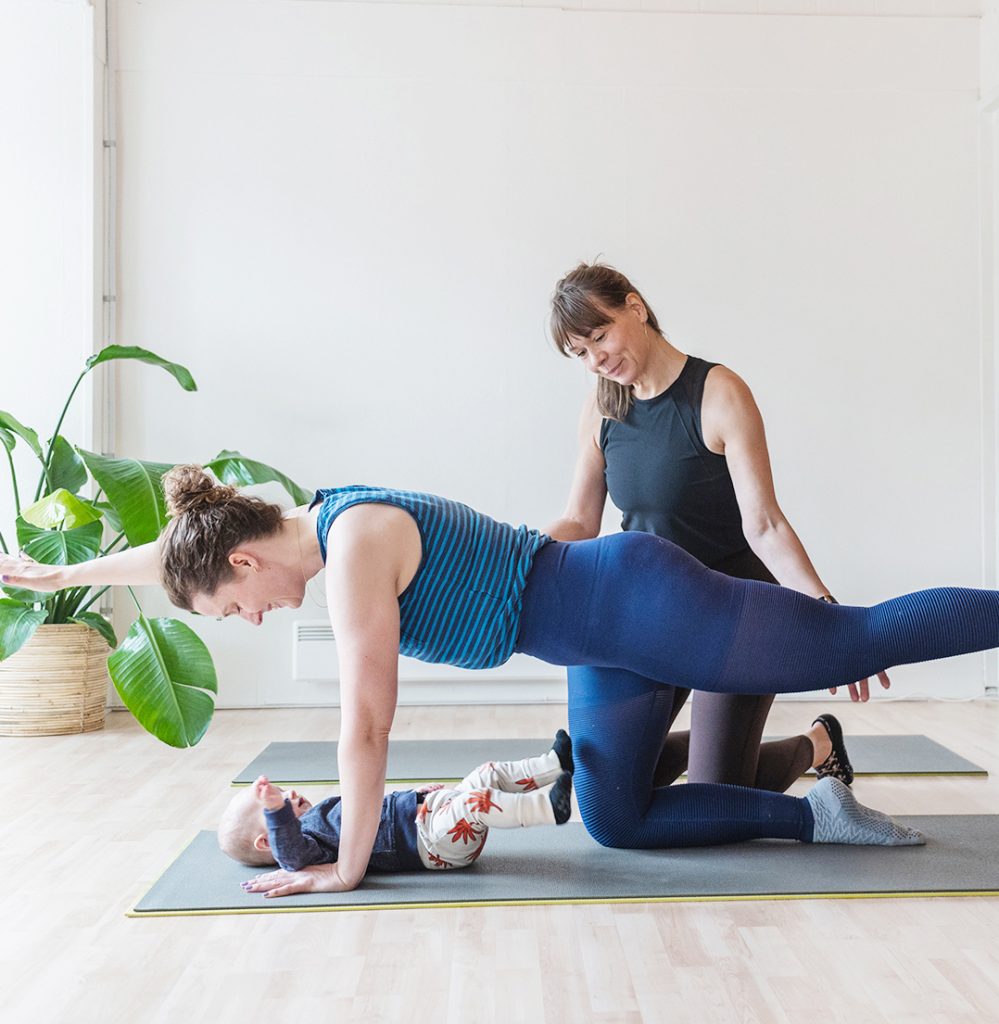
PILATES DURING AND AFTER PREGNANCY
Pregnancy Pilates; During your pregnancy, Pilates is a good method to stay strong, fit, and flexible. It is possible to attend regular group classes until approximately 16 weeks. As your baby, and therefore your belly, grows, there will be increasingly more exercises in the group classes that no longer feel comfortable or beneficial for you. At that point, you can switch to a special pregnancy training program: Pregnancy Pilates.
Due to the increasing weight and size of your baby and belly, your lower back and pelvis will be under increasing strain. Good stabilization is the foundation for good posture. This can prevent and alleviate many pregnancy-related complaints later on. During pregnancy, the leg muscles also deserve extra attention, so that your legs, rather than your back, can support all those extra kilos.
In the pregnancy classes, there is ample opportunity to address your specific needs and (prevention of) complaints that may arise during your pregnancy. In principle, this is possible until the end of your pregnancy. Pregnancy Pilates is on the schedule; you can book this class online. It is also possible to take private Pregnancy lessons at Pilates Noord.
Check the schedule here for current days and times.
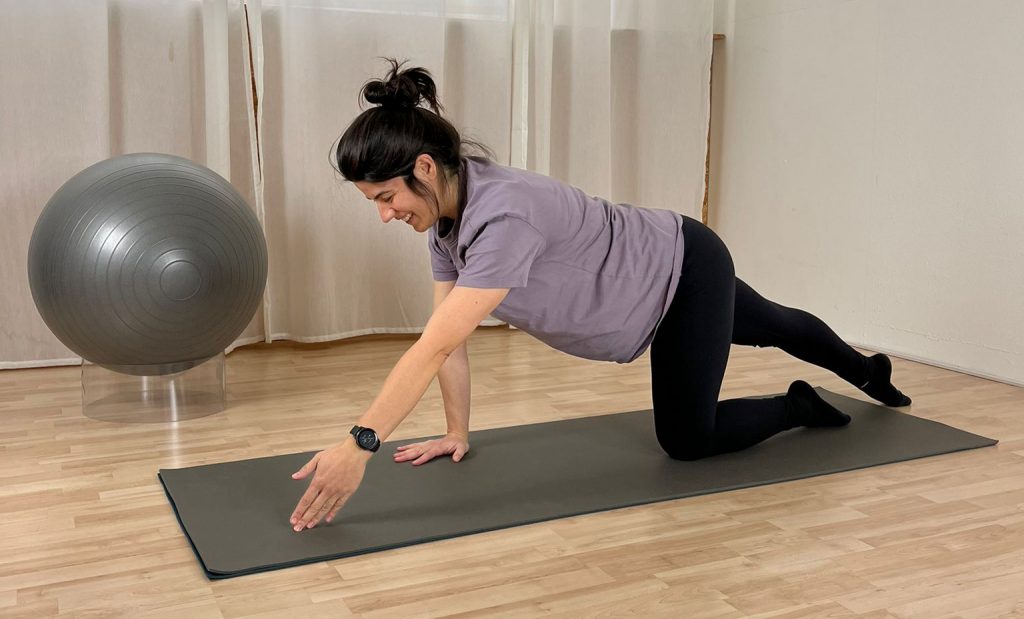
After giving birth, Pilates is a good method to rebuild your stability and strength in a responsible way. This is possible after both a natural birth and a caesarean section.
For this period, there is the Care For Your Core class , a class that is ideally suited as a postnatal Pilates class. Often, the sense of one’s own body changes significantly after the birth of a child. Muscles that were easy to control before pregnancy seem to have disappeared after delivery. It requires attention and patience to regain the necessary control and awareness of these muscles. In the class, we pay close attention to breathing, deep abdominal and back muscles, and pelvic stability.
This class is also suitable if you gave birth some time ago and have resumed your regular training but notice that control over your “core”—including your deep abdominal and pelvic floor muscles—is not yet optimal, and/or if you experience pain around the pelvis. Restore Your Core Pilates classes can be taken both in the studio and online.
Check the schedule here for current times and book your class directly.
Do you have any further questions? Send an email for more information about Pilates training after childbirth.
In all cases, take the following basic guidelines into account:
•Listen carefully to your recovering body.
• Allow for a longer recovery time after a difficult delivery or Caesarean section.
• Drink enough water before, during, and after training. Especially if you train while breastfeeding.
• Have a healthy snack before and after training.
• Do not completely exhaust yourself during the training.
Would you like more info about prenatal Pilates in Amsterdam North? Click here to send an email.
We look forward to seeing you in the studio!
“Can I train my abdominal muscles during pregnancy?” This is a frequently asked question regarding prenatal training.
And the answer is twofold: Yes and no. Training the rectus abdominis muscles, your “six-pack” muscles, is discouraged during pregnancy after the first trimester because it puts a lot of pressure on the pelvis, pelvic floor muscles, and abdominal wall. This can increase diastasis recti and cause pelvic (floor) complaints. These exercises are also of no use; your belly gets bigger during pregnancy and the rectus abdominis muscles essentially shift apart, making the midline much wider. This is a natural process, and you do not want to stop it.
Therefore, you should avoid all exercises where your head, neck, and shoulder blades are off the mat, such as sit-ups and crunches, during pregnancy.
But you don’t just have rectus abdominis muscles; you also have transverse and oblique abdominal muscles. And it is precisely those transverse abdominal muscles that you *do* want to train. These transverse abdominal muscles (transversus abdominis) lie like a kind of corset around your waist. The deep layer of abdominal muscles, together with the diaphragm and your pelvic floor muscles, form an important part of your core.
You can safely train these transverse muscles, and it is also important to keep them strong. Training the transverse abdominal muscles stabilizes your torso (“core stability”), which can prevent back and pelvic (floor) complaints. You can also lightly train your oblique abdominal muscles during your pregnancy. You continuously use your oblique abdominal muscles in daily life; think, for example, of looking over your shoulders or reaching diagonally forward or downward.
What is especially important during your pregnancy is that you continue to activate your core muscles in a gentle way. If you experience pain and are unsure whether an exercise is suitable for you, consult your doctor, physiotherapist, or midwife.